
Let’s welcome creative mastermind Johanna Kleive to my little blog. She is a drummer in a Norwegian feministic Black Metal band called Witch Club Satan, a writer and a wonderful being and an innovator and creator of Kreativt Kollektiv. She plays drums, she writes words beyond beauty and brings people together and unites. I could go on and on but let just give her the words 🙂 I recommend opening a glass of Heks along with this awesome interview!
Give it up for a glass of wine with Johanna Kleive:
Who are Witch club Satan? What is the original idea behind this incredible female black metal band?
Witch Club Satan grew out of a previous collaboration between Victoria, Nikoline and me, a project that combined theatre and music in a kind of punk spirit. At first, we even played with the idea of making indie techno rap, but quickly realized that black metal was what gave us the expression we were really looking for. Haha!
In 2021, we experienced a strong frustration with the status quo. We felt a sense of apathy and passivity, both within ourselves and in the society around us, while the world seemed to be moving toward ever greater crises. For us, it became crucial to break out of that state and “wake ourselves up,” and music became the means to do exactly that: to make as much noise as possible, both literally and politically.
In this context, black metal emerged as the most natural choice. The genre holds a deep sense of anger and an inherent drive for rebellion, almost like the role of punk within metal, where energy, intensity, and expression matter more than technical perfection. This was where we felt we could find our place and our language.
At the same time, the project was never purely musical. By incorporating theatre, ritual, and physical expression, we continue a performative dimension that was already present in our earlier work. This makes Witch Club Satan function as much as an art project and a collective as it does a band.
The starting point can therefore be understood as a deliberate gesture: we took a genre already known for its extremity, shock, darkness, and ideological weight, and asked what happens when this expression is moved into a feminist, artistic, and political framework. The result is not just a continuation of the black metal tradition, but a transformation of it, where female rage, the body, and history are given new meanings and new voices.
Do you find it hard to be in a scene that is mostly male driven?
Of course it can be challenging from time to time. There will always be men finding our boobs more interesting than our music;-)
Being a woman in a male-dominated genre like black metal comes with its own set of challenges. There are still expectations, stereotypes, and sometimes resistance, both subtle and explicit, about who belongs in the scene and what that presence should look like. But rather than seeing this only as a limitation, it can also be a source of creative energy.
Precisely because the genre has been so heavily coded as masculine, it opens up a space where our presence can disrupt and reframe what black metal is allowed to be. In that sense, it’s still possible to shock, even in 2026!
Do you think metal and wine have much in common?
Absolutely. First of all, there’s a kind of primal presence in both wine and black metal that I find deeply fascinating. There’s something fundamental about them—something raw and irreducible. What I love about black metal is that, at its best, it doesn’t try to imitate anything. It just is. And I think the same applies to a good natural wine: it speaks honestly from where it comes from.
Wine, like black metal, should be alive, personal, and truthful. Not necessarily “funky” for the sake of it, but real. A natural wine that just ends up tasting like junk food? Completely uninteresting. It has to carry intention, care, and a sense of origin.
More and more people are beginning to understand how important it is to know the source of what they consume. Where it comes from, who made it, under what conditions. That awareness creates a deeper connection, to the land, to the process, to the people behind it.
And honestly, I fucking love wine because cultivating it is about an endless interplay of tiny details. If a winemaker overlooks just one step, everything that follows becomes more complicated. In the end, wine is the result of precision and care, a chain of decisions that culminates in something you can hold in your hand, sometimes decades later.
You open a bottle of wine because you want to feel something. Together with others. It’s a form of craft you can physically hold, a label that points to a specific year, a specific piece of land, a specific fate.
As the black metal band Spectral Wound put it in the excellent fanzine Blood of Gods. The truth is in the glass, but understanding comes from engaging more deeply with the craft, its history, its traditions, its labor. In that sense, you should approach wine the same way you approach music: with curiosity, attention, and respect. If you do, it will give something back.
We are curious – what drinks or wines are on your rider?
We’re not quite in a position to be divas about it. Tet. That said, I wouldn’t complain if there was Champagne on every rider. Champagne is one of those rare things that works no matter the context, and there’s something about that kind of effortless luxury that I really appreciate.
But in reality, our only real request is quite simple: natural wine. Wines made with care, organic, biodynamic, or otherwise rooted in sustainable practices, where you can actually taste a sense of place. Unfortunately, what we usually end up getting is pretty shitty supermarket wine. Me and our booking agent Zoltan complain about it constantly. There was one exception though, when we played in Madrid, and someone had actually made the effort to find something genuinely drinkable. That really stayed with us.
And actually, our relationship kind of says everything about this crossover between wine and metal, Jas! You and I met through a shared passion for both. I remember you texting me when we were playing in Germany last year: “Hey, some friends say we have a lot in common, can I come to your show and bring some wine as a trade?” I had no idea what to expect.
Then you showed up with two full cases, 60 bottles, of incredible wine. And on top of that, it was called Heks. Some coincidences are just too perfect to ignore. We’ve been friends ever since.
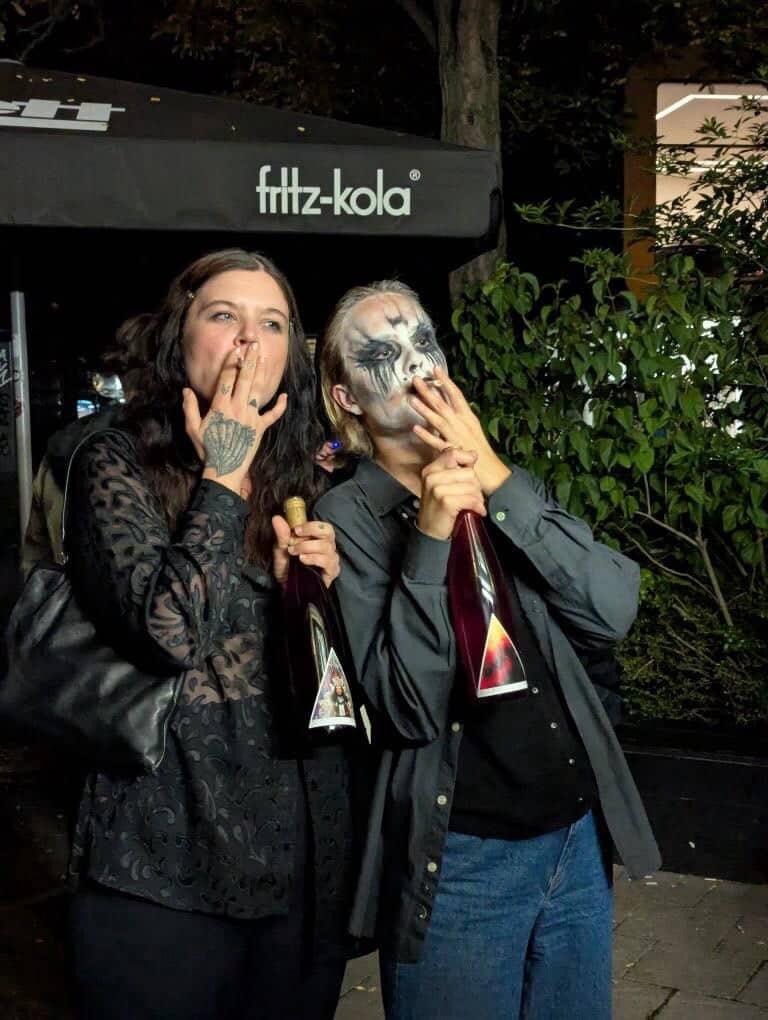
(Jasmin is blushing at this point)
Besides being a badass drummer, you are also a very talented writer. You write a lot about food and wine in Norway. What do you need to find inspiration and focus to write?
Haha, thank you for the compliment!!
What is needed is this, and this alone, says the famous writers: solitude. What unfolds in your innermost being is worthy of all your love. And yet, I have to admit, my inner world would be unbearably poor without the impulses that come from other people, from encounters, from lived experience. The ability to write depends on having ideas, and ideas are everything.
The problem is not their absence, but our ability to see them. Especially when the days begin to blur, on tour, for instance, when everything repeats itself: early mornings at airport, nine hours of driving, another anonymous backstage room. At times I’ve cracked mentally, exhausted, aching, wondering why I keep doing this at all.
Before the last European tour with Avatar and Alien Weaponry, I even had anxiety attacks. I questioned whether this life was really meant for me. But then I made a decision: to be fully present. To act with intention. To listen, really listen, to the people around me, with renewed curiosity. And I thought of Rainer Maria Rilke, who wrote: “If your everyday life seems poor, do not blame it; blame yourself… tell yourself you are not poet enough to summon up its riches.”
So I began to remember things.
A quiet neighborhood in Chiswick. Unbelievable sardines at a random Spanish restaurant. A silent Valentine’s morning with Hedda, the first trace of spring, and the fragile belief that maybe I will find love again. A world-class bookshop where time dissolved. The best wine I’ve ever had, in some unremarkable Swiss neighborhood.
I remember the shows where my band truly connected. Where something opened. Where rage was released. That incredible pull in my stomach, the certainty that what we are doing is real.
Midnight bowling on a Sunday. Karaoke after a show on a Tuesday. Too much alcohol. Too little sleep. Twice the laughter. And then the conversation, long, drifting, essential, with fellow bohemian musicians, at three in the morning, in a random McDonald’s. This is where the ideas come from. Not in spite of the chaos, but because of it.
You just founded a collective in Oslo – what can you share with us about Kreativt Kollektiv? What is the idea and who is it focused at?
I have! And it’s so exciting that you’re part of the collective. To be honest, I was completely overwhelmed when I hit “publish” on Instagram and the responses just kept pouring in. In less than a week, almost 200 people had sent thoughtful emails, sharing their dreams of a community like this in Oslo.
For a long time, I’ve been reflecting on, and dreaming of, a space where creative people can meet to talk, develop, and collaborate on artistic and performative processes. I moved back to Norway this spring after three years in France, what I would call a kind of formative journey. That country taught me how to live.
When I returned to Oslo, I knew I had to continue cultivating that way of life. I became more outgoing, more proactive. And to my great joy, it seems that many of us are meeting in the same place: a kind of hunger. Shared interests. People who may not be fully established yet, but who are deeply engaged in a range of creative projects, and who are searching for one another.
This is the beginning of such a space. On Thursday, February 5th, exactly one month after I posted on Instagram, we hosted the very first demo gathering of what is now called Kreativt Kollektiv: a forward-thinking collective for creatives across disciplines and industries. Artists, chefs, musicians, architects, psychologists, philosophers, performers, and cultural workers, all coming together with the aim of building a long-term, living community where ideas actually become reality.
The collective is growing every day. This is not a one-off event, but the beginning of something long-term: a cooperative where each member contributes a share, and everyone takes part in carrying it forward. We envision a community built on the exchange of skills and services, people drawing on each other’s strengths. A place where the most driven individuals find one another, share generously, and inspire each other. A space you don’t enter without contributing, bringing the very best of yourself, whatever that may be, to elevate the whole.
A network you want to be part of. Rooted in deeply human values. Not defined by heavy financial commitments, but by artistic energy, openness, and a shared mental space. I’m incredibly excited to see what this can become.
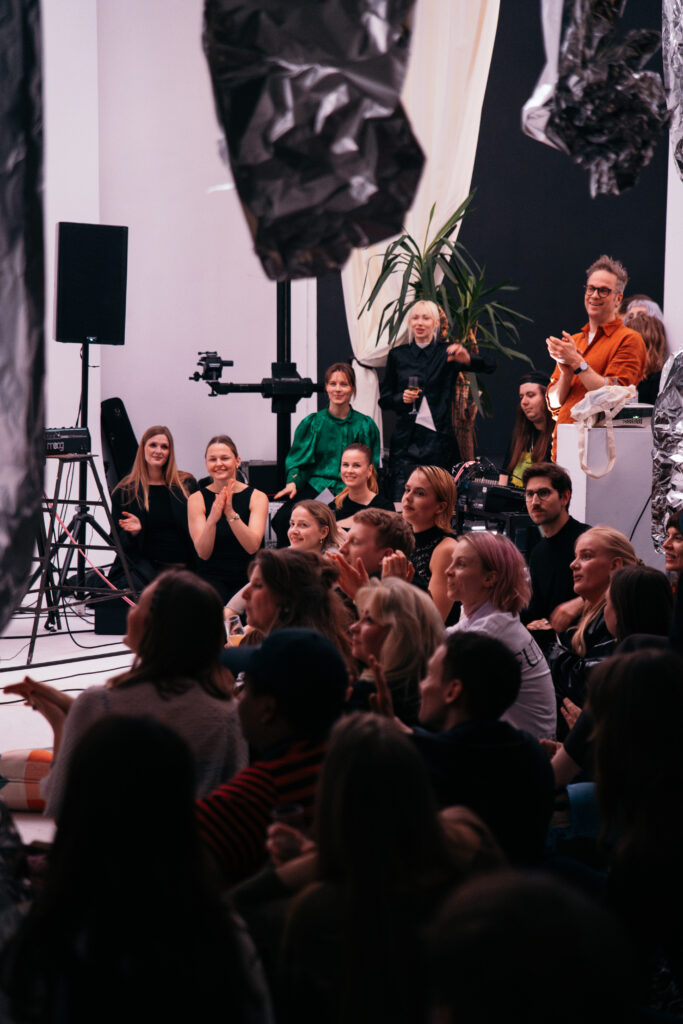
Picture credit: Oystein Kind
Thank you Johanna! Reading this I know we have even much more in common than we have been able to share with another so far. Feeling touched and inspired.
Please check out Johanna Kleive and her incredible projects on social media:
@johannakleive
@witchclubsatan
@kreativtkollektiv
If you ever get the chance to see Witch Club Satan live btw, it is incredible. You will never look back.
I am so excited to come and show my wines with Kreativt Kollektiv in Oslo in the future and will update y’all on these dates when they are confirmed.